

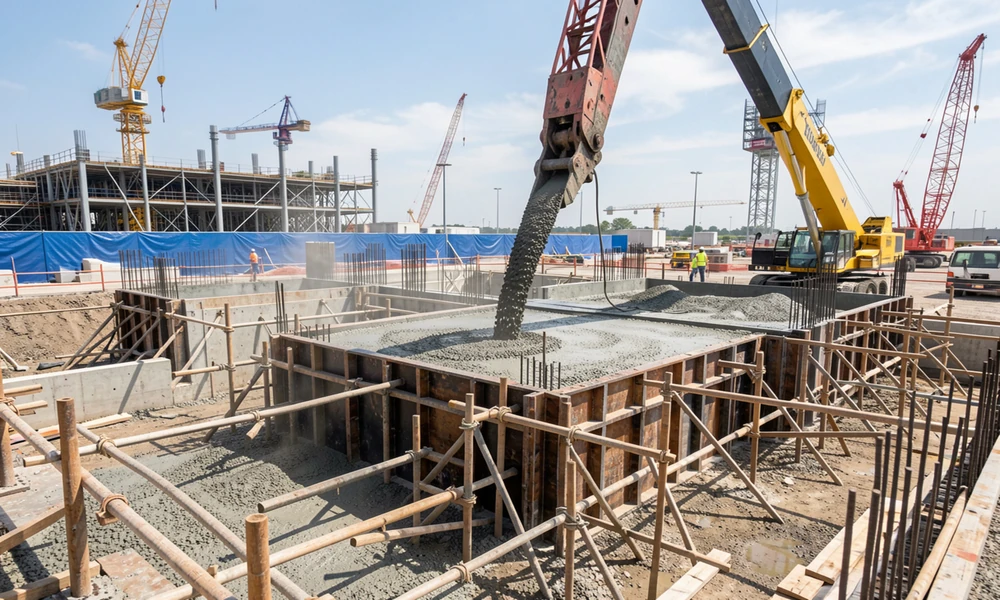
Normal foundation techniques are of no use when it comes to construction in coastal and sea areas. They need to sustain heavy loads on various ground conditions. In cases of poor soils, high groundwater levels, or proximity to the coastline, Deep foundation services in New York are one example of the engineering techniques employed to transfer loads to a more stable rock or soil. Continuous Flight Auger Piles, Drilled Shafts, Micro piles, Helical Piles, and Driven Piles are some of the types of piles.
CFA and FDP
CFA stands for Continuous Flight Auger piling system, a deep foundation technique that involves CFA for digging. Once the desired level is reached, concrete or grout is pumped in through the central stem of the auger while being extracted. Finally, the reinforcement is inserted into place.
As the CFA piling system is a quiet and vibration-free operation compared to some impact piles, it allows for its use near existing structures. At the same time, the CFA piling procedure is characterized by high complexity and the necessity to keep drilling depth, pressure and extraction speed under strict control.
Then there are other foundations known as Full Displacement Piles (FDP). Unlike the piles described above, in the case of Full Displacement Piles (FDP), instead of removing large amounts of soil, the space is created for the pile by displacing it. It involves less waste and tightens the surrounding soil area.
Drilled Shafts and Caissons
Drilled Shafts are also known as Caissons in some applications, which involve deep foundations created through a process of excavation and subsequently filling it with reinforced concrete. Such a type of foundation system is able to bear considerable load capacity for applications such as bridges, waterfront structures, buildings, and more.
The load capacity of such a foundation system depends upon factors such as shaft diameter, depth, type of soil or rock, and the relationship between the foundation system and the surrounding soil or rock. In the case of the presence of groundwater or loose soil, the use of temporary casings or special drilling fluids becomes necessary.
Mini Piles and Micro Piles
Mini piles and micropiles are small foundation supports that can be placed in the ground where there is not enough room for regular piling machines. These types of foundation structures involve steel bars or a steel tube set inside the concrete and are often employed for upgrading existing foundations, providing support to extensions, or transferring the load through weak soil. Due to their equipment needs being rather compact, they are sometimes applicable to urban areas where space is limited. In spite of their small diameters, micropiles have great bearing capacity provided that they are correctly designed and installed.
Helical Piles
Helical piles are made up of steel shafts that have one or more helical plates. The process of installation is achieved by drilling the pile into the ground to the desired depth and installation resistance. Helical piles could present many benefits where excavation and curing of concrete is not needed, and thus are suitable to be used where specific requirements are met. In areas where moisture and salt can cause rust or damage, this risk must be considered.
Driven Piles
Driven piles are forced into position by impact or vibratory action so as to bury the piles underground. Driven piles are made up of materials such as steel, precast concrete, and timber. Driven piles carry loads via weak soils in the upper strata into stronger strata beneath, or resist via friction on the piles. They are mostly used in construction in coastal areas and underwater, such as piers, docks, bridges, and retaining walls. Driven piles’ installation is noisy and involves movement of the soil, which might interfere with surrounding buildings and the environment.
Selecting an Appropriate Foundation
Deep foundations have their strengths and weaknesses. Factors such as soil conditions, structural load considerations, access to the site, environmental restrictions, and cost of construction determine which technique is selected. Projects in the coastal region also take into account issues like water table, erosion, corrosion, and marine exposure. This helps engineers choose the right deep foundation method for each project. In considering drilled shafts, micropiles, helical piles, and driven piles, it is evident that Deep foundation services in New York are representative of the broader scope of speciality foundation engineering.